Wednesday, 10 June 2026

Hundreds of Thousands of Travelers Stranded as Middle East Airspace Closes Amid Escalating Conflict

Published: Monday, March 02, 2026
Hundreds of Thousands of Travelers Stranded as Middle East Airspace Closes Amid Escalating Conflict
Source: Arab News

Hundreds of thousands of travelers were left stranded across the Middle East on Sunday after coordinated U.S. and Israeli attacks on Iran triggered widespread airspace closures and airport shutdowns, paralyzing one of the world’s busiest aviation corridors.

Tourists and business passengers crowded hotels and terminals, scrambling to rebook flights or reach airlines through overwhelmed call centers. With little clarity on when airspace would reopen, several governments advised their citizens to shelter in place.

Major regional hubs — including Dubai International Airport, Abu Dhabi’s Zayed International Airport and Hamad International Airport in Doha — suspended operations following reported strikes. Dubai International, among the busiest airports globally and a key transit point between Europe, Africa and Asia, was among those affected.

In Dhaka, Bangladesh, prospective migrant worker Mohammad Abdul Mannan waited anxiously at Hazrat Shahjalal International Airport, determined to depart for the Gulf despite the escalating conflict.

“We have set out to go for work, and we must go,” he said. “My only concern is how to go abroad and how to earn an income.”

In Dubai, witnesses reported hearing fighter jets overhead and explosions, including a missile strike that hit the Fairmont Palm Hotel. Emirates Airline suspended all flights to and from Dubai until at least Monday afternoon, leaving thousands seeking alternative arrangements.

Louise Herrle and her husband, returning to Pittsburgh after touring Dubai and Abu Dhabi, saw their Washington-bound flight canceled with no immediate option to reschedule.

“We’re in the hotel room, we are not leaving it,” Herrle said. “You’re not going to give it up until we know we have a flight out of here.”
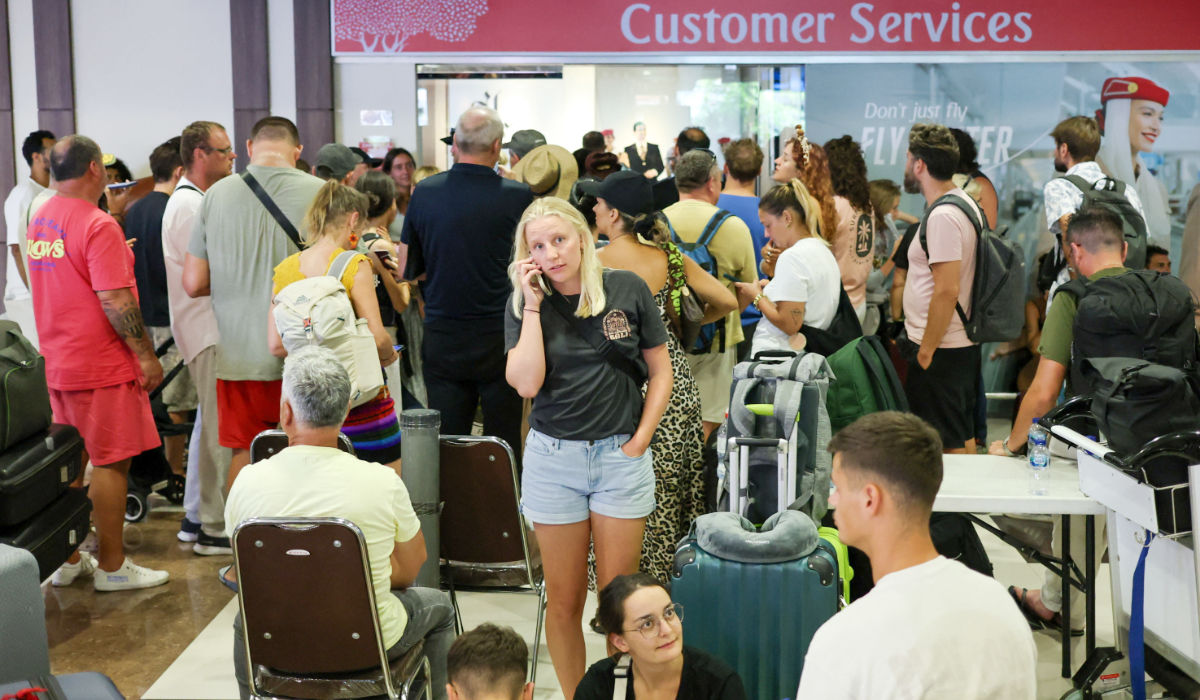
Thousands of Flights Canceled

Aviation analytics firm Cirium said the total number of stranded passengers is difficult to determine. However, it estimates that roughly 90,000 travelers transit daily through Dubai, Doha and Abu Dhabi on Emirates, Qatar Airways and Etihad Airways alone.

Airspace closures extended across Israel, Qatar, Syria, Iran, Iraq, Kuwait, Bahrain, Oman and the United Arab Emirates, according to flight-tracking services and government notices. More than 2,800 flights were canceled Sunday across the region, including in Saudi Arabia, Jordan and Egypt, according to FlightAware data. Major international airports — including London, Mumbai, Delhi, Bangkok, Istanbul, Colombo and Paris — also reported dozens of cancellations.

Air India suspended flights to and from the UAE, Saudi Arabia, Israel and Qatar until Tuesday. Israel’s EL AL said it would prioritize repatriating stranded citizens once airspace reopens and halted ticket sales for flights through March 21 to accommodate affected passengers.

UAE authorities confirmed casualties from the strikes. Officials at Dubai International Airport reported four injuries. Abu Dhabi’s Zayed International Airport said one person was killed and seven others injured in a drone strike. Kuwait International Airport also reported strikes. Iran has not publicly claimed responsibility.

Disruptions Expected to Persist

Airlines urged passengers to verify flight status online before traveling to airports. Several carriers offered rebooking waivers or full refunds, though industry analysts warned that disruptions could continue for days.

“For travelers, there’s no way to sugarcoat this,” said Henry Harteveldt, president of Atmosphere Research Group. “You should prepare for delays or cancellations for the next few days as these attacks evolve and hopefully end.”

Former Federal Aviation Administration official Mike McCormick said airspace may gradually reopen once military authorities clarify operational zones and assess ongoing missile threats.

The impact has rippled far beyond the Middle East. In Bali, Indonesia, more than 1,600 tourists were stranded after five Middle East-bound flights were canceled or postponed, airport authorities said.

Airlines operating long-haul routes through the region have begun rerouting flights south over Saudi Arabia, increasing travel times and fuel costs.

Kristy Ellmer, an American business traveler in Dubai, said she has booked multiple flights in anticipation of sudden reopenings while remaining cautious amid continuing explosions.

“You hear a lot of explosions at times — hundreds of them,” Ellmer said. “When we hear them, we don’t stay near the windows just in case the glass breaks.”

With airspace closures still in effect and tensions high, travelers worldwide face continued uncertainty as aviation authorities assess the security situation across the region.

Kuwait Restores Air Traffic Following Brief Airspace Suspension

Published: Monday, June 08, 2026
Kuwait Restores Air Traffic Following Brief Airspace Suspension

Kuwait reopened its airspace on June 6 following a temporary suspension implemented as a precautionary step after regional security developments involving Iran’s ballistic missile attacks, according to the Kuwait Public Authority of Civil Aviation (PACA).

In a statement shared with the Kuwait News Agency (KUNA), PACA said relevant authorities promptly activated established emergency procedures and operational plans aimed at safeguarding passengers, flight crews, and civil aviation infrastructure.

The airspace closure was in effect from 4:15 am to 6:15 am local time. During this period, 11 flights operated by Kuwait Airways and Jazeera Airways were redirected to nearby airports as part of safety measures to ensure uninterrupted protection of passengers and operational continuity.

The authority noted that following coordination with competent agencies and an assessment confirming improved conditions, air traffic operations were resumed at 6:15 am.

After the reopening, flights that had been diverted to destinations including Dammam and Riyadh resumed their original routes and continued normal operations.

Source: ZAWYA

Qatar Rejects Airspace Closure Rumours, Confirms Flights Operating Normally

Published: Monday, June 08, 2026
Qatar Rejects Airspace Closure Rumours, Confirms Flights Operating Normally

The Qatar Civil Aviation Authority (QCAA) has dismissed reports circulating on social media alleging that the country's airspace has been closed or that flight operations have been suspended.

In a statement issued on Sunday, the authority described the claims as inaccurate and urged the public to rely exclusively on official sources for information related to aviation activities and operational updates.

The QCAA explained that the current Notice to Airmen (NOTAM) issued by the authority is designed to establish alternative routing options for aircraft. The measure aims to maintain air navigation services while ensuring the highest standards of safety, efficiency, and operational continuity.

According to the authority, the action was introduced in response to prevailing circumstances and is consistent with internationally recognized aviation regulations and best practices.

The regulator emphasized that air navigation services across Qatar remain fully operational and clarified that the NOTAM should not be interpreted as an indication of airspace closure or a halt to flight operations.

The QCAA also urged the public to avoid spreading rumours and unverified reports, stressing the importance of obtaining information through official communication channels.

Source: ZAWYA

IATA Official: Jet Order Delays Due to Iran Conflict Could Prove Expensive for Carriers

Published: Sunday, June 07, 2026
IATA Official: Jet Order Delays Due to Iran Conflict Could Prove Expensive for Carriers

A senior official from the International Air Transport Association (IATA) has cautioned Middle Eastern airlines against postponing aircraft orders despite rising costs and market uncertainty linked to the war in Iran, warning that such delays could become financially disadvantageous over time.

Kamil Al-Awadhi, IATA’s Regional Vice President for Africa and the Middle East, said he does not anticipate that the ongoing conflict or increased operating costs will significantly disrupt aircraft purchasing plans among carriers in the region. Speaking to reporters on Saturday during the association’s annual summit in Rio de Janeiro, he noted that Middle Eastern airlines remain among the largest global buyers of aircraft from manufacturers Boeing and Airbus.

Al-Awadhi said deferring aircraft orders is “not wise,” arguing that delays could ultimately increase costs for airlines due to extended waiting periods for new aircraft deliveries. He added that current production backlogs at manufacturers mean operators already face long lead times, particularly for the latest-generation single-aisle aircraft.

According to him, it could take several years for airlines to receive newly ordered planes, making postponements potentially counterproductive. He said most carriers are expected to continue with their existing fleet expansion strategies despite temporary disruptions.

“The plan is to continue where we're going … even though this is a hiccup,” he said.

Across the global aviation sector, airlines have been adjusting operations by reducing flight frequencies and increasing fares and ancillary charges in response to higher costs. This comes even as parts of the Middle East aviation network have experienced security risks, including airspace disruptions linked to the conflict.

Al-Awadhi also expressed concern over recent developments in Kuwait, where an attack earlier in the week at an airport killed one person and damaged a terminal used by international carriers. He said preliminary assessments suggest the affected infrastructure could take at least a year to fully restore.

“Looking at the damage from the videos and pictures that were sent to me, it’s going to take ages,” he said. “So my concern is, will the other carriers be able to go into Kuwait?”

He added that authorities may need to accelerate completion of sections of a new airport terminal or temporarily reassign international operations to facilities currently used by domestic airlines such as Kuwait Airways. He described the situation as one that would require complex logistical and operational decisions to resolve.

Source: Reuters

German Airports Warn of Widespread Flight Cancellations Impacting Millions of Passengers

Published: Monday, May 11, 2026
German Airports Warn of Widespread Flight Cancellations Impacting Millions of Passengers

The Association of German Airports (Association of German Airports (ADV)) has issued a warning that the aviation sector may soon face widespread disruption as jet fuel supply pressures continue to intensify.

Speaking to the Sunday edition of Germany’s Welt newspaper, ADV chief executive Ralph Beisel said airlines are increasingly likely to cancel services, particularly low-cost carriers and routes considered less essential for tourism demand.

Beisel noted that under an optimistic outlook for 2026, passenger traffic would remain stable. However, he cautioned that a more severe scenario could see airport capacity fall by around 10 percent. Across the aviation network, that reduction could translate into disruptions affecting as many as 20 million travellers.

Such a decline would likely lead to certain destinations losing direct connectivity altogether, while others would see fewer available flights and higher fares due to constrained supply.

The association pointed to geopolitical tensions affecting global energy flows as a key factor behind the disruption. The conflict involving Iran has unsettled oil transportation routes through the Strait of Hormuz, contributing to rising jet fuel costs.

According to Beisel, jet fuel prices have remained at roughly double pre-conflict levels for more than two months, with no immediate relief expected. He added that even when fuel is available, current price levels make it difficult for airlines to operate many routes profitably, raising the likelihood of further schedule reductions in the months ahead.

Source: Oman Daily Observer

Europe Prepares Alternative Aviation Fuel Measures Over Supply Fears

Published: Monday, May 11, 2026
Europe Prepares Alternative Aviation Fuel Measures Over Supply Fears

Europe’s aviation sector is preparing contingency measures to address potential jet fuel shortages caused by escalating tensions in the Middle East, prompting regulators to approve broader flexibility in fuel use across the region.

The European Union Aviation Safety Agency (EASA) announced Friday that supply disruptions affecting the Middle East and Arabian Gulf have impacted the availability of Jet A-1 fuel, the standard aviation fuel used throughout Europe. In response, regulators and fuel providers are assessing the wider adoption of Jet A fuel, a similar grade commonly used in North America, including for aircraft traveling to European destinations.

EASA issued updated operational guidance intended to help airlines, airports, and fuel suppliers safely manage the introduction of Jet A into European aviation systems. Although Jet A and Jet A-1 are closely related fuels, the agency noted that they differ in several technical aspects, including freezing point and electrical conductivity, which require additional safety precautions during operations.

The regulator cautioned that introducing Jet A into infrastructure traditionally designed for Jet A-1 could pose operational and safety challenges if the transition is not carefully coordinated across the aviation industry. EASA emphasized that effective implementation would depend on close collaboration between airports, fuel companies, airlines, and aircraft manufacturers.

The European Commission also released separate recommendations aimed at helping the transport sector respond to any future fuel supply disruptions linked to the Middle East conflict. While the Commission said there were currently no jet fuel shortages reported across the European Union, it stressed the importance of preparedness measures to maintain safe and uninterrupted flight operations.

The International Air Transport Association (IATA) echoed concerns about the potential impact of prolonged regional instability on global aviation fuel supplies. Stuart Fox, IATA’s director of flight and technical operations, said allowing European carriers greater flexibility to alternate between Jet A and Jet A-1 fuel, similar to practices already used in Canada, could provide airlines with more operational options during supply shortages.

Fox said the transition would require strict operational oversight, particularly for flights operating in colder regions, where Jet A’s higher freezing point must be taken into account during route planning and aircraft performance calculations.

He also noted that airports and fuel suppliers would need structured procedures for introducing the alternative fuel grade safely, including updated handling processes, clear labeling systems, communication protocols, and enhanced quality control measures.

Europe has experienced increasing pressure on energy and aviation fuel costs as instability in the Middle East continues to disrupt shipping routes through the Strait of Hormuz. European refineries currently supply around 70% of the bloc’s jet fuel demand, while the remainder is imported, largely from Gulf nations.

Last month, International Energy Agency Executive Director Fatih Birol warned that continued disruptions could lead to jet fuel shortages across Europe within a relatively short period.

Source: Anadolu Ajansı