Thursday, 11 June 2026

Lusail Circuit Launches Citywide Art Installation for Qatar Grand Prix

Published: Wednesday, November 26, 2025
Lusail Circuit Launches Citywide Art Installation for Qatar Grand Prix

Doha has taken on a new artistic identity ahead of this year’s FORMULA 1® QATAR AIRWAYS QATAR GRAND PRIX, with ten towering Formula 1® helmet sculptures installed across the city as part of a large-scale public art initiative led by Lusail International Circuit (LIC).

Standing at 1.8 meters tall, the installations—on display through 30 November 2025—feature works by eight prominent Qatari artists, each weaving themes of heritage, identity, and innovation into the universally recognized symbol of motorsport.
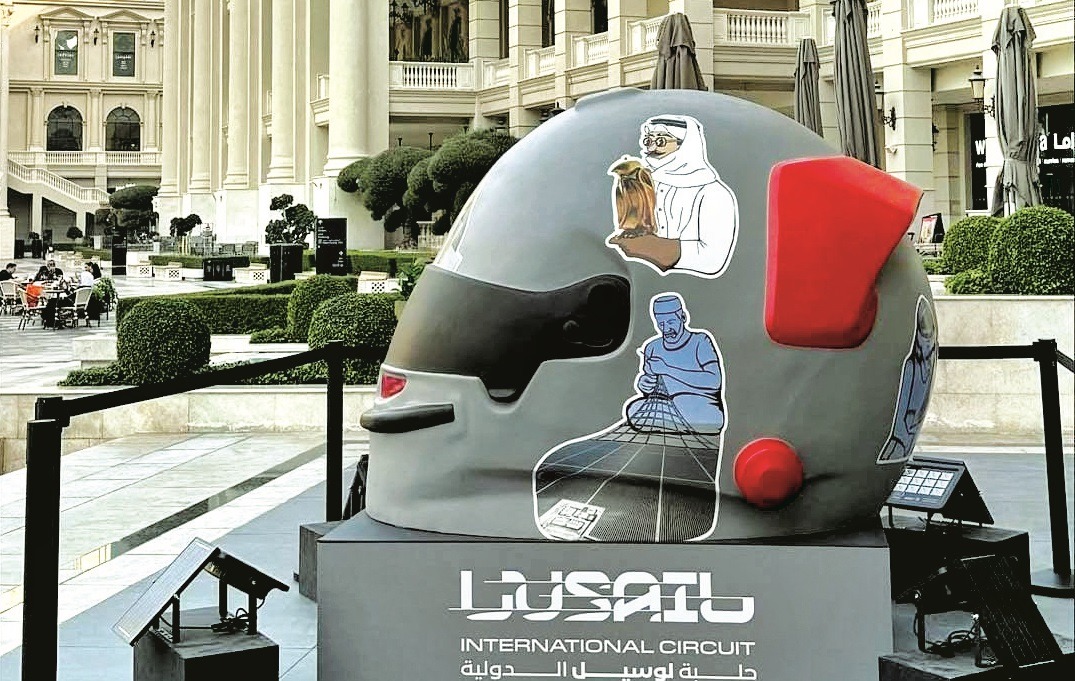
Two official LIC-branded helmets greet travelers and media personnel at Hamad International Airport and the St. Regis Doha, while the other pieces appear at key cultural and commercial landmarks:

Old Doha Port – The Rise of Glory by Fatima Mohammed Shaker
Shaker blends Qatar’s map with symbols of national pride, capturing a sense of authenticity and forward momentum.

Doha Festival City – Connections by Hala Al-Darbasti
A vibrant acrylic work exploring the small yet powerful details that link individuals to one another. Al-Darbasti described the experience as “deeply meaningful,” noting her pride in contributing to Qatar’s motorsport scene.

Lusail International Circuit – The Camel by Laila Al-Qaedi
Traditional camel markings are reimagined as dynamic, racing-inspired motifs, drawing parallels between desert endurance and Formula 1® performance.

Msheireb Downtown – Heritage in Acceleration by Noor Abuissa
Islamic geometric patterns and Doha’s skyline appear in fluid motion, capturing the synergy between spiritual symmetry and racing speed.

Place Vendôme – Fusion of Speed and Heritage by Jaber Henzab
A bold composition that merges Qatari craftsmanship with the precision of F1®. Henzab called the project a “meaningful milestone” in his career.

Qatar Foundation – Velocity of Heritage by Kaltham Al-Fakhroo
Architectural motifs from Qatar’s historic buildings intertwine with the circuit’s high-energy character. Al-Fakhroo said the collaboration reaffirmed LIC’s “unique aura.”

Souq Waqif – The Land of Abundance and Oysters by Zainab AlShibani
A poetic tribute to pearl divers, connecting maritime tradition to the discipline and bravery found in racing.

VVIP Lounge, LIC – The Falcon: A Renewed Legacy by Noura Abdulrahman Al Ibrahim
A Saker falcon—symbol of strength—takes on a futuristic feel, revealing the technological complexity hidden inside an F1® machine.
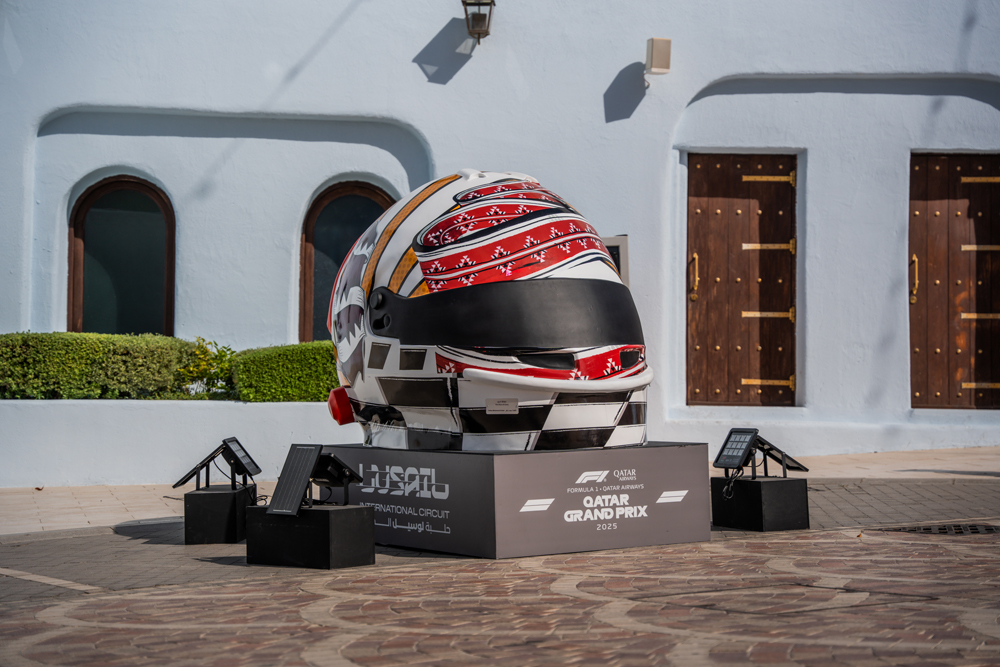
Fatima Al Qaedi, LIC’s Marketing Manager, described the exhibition as a tribute to “Qatari imagination and artistic excellence.” She highlighted how each helmet transforms the essence of the nation—from pearl diving to falconry—into contemporary visual narratives. “We encourage residents and visitors to follow the helmet trail and see Formula 1® through a uniquely Qatari perspective,” she said.
Race Weekend Line-Up
Fans still have a chance to secure one of the remaining tickets for the 2025 Qatar Grand Prix, running 28–30 November:

Friday, 28 November: Opening ceremony, F1® practice, Sprint Qualifying, support races, and a performance by Seal.

Saturday, 29 November: High-energy F1® Sprint Race, FIA Formula 2™ and Porsche Carrera Cup Middle East action, capped by a concert from Cheb Khaled.

Sunday, 30 November: The main 57-lap Grand Prix, preceded by the Drivers’ Parade and final support races, closing with a headline show by Metallica.

Tickets are available at tickets.lcsc.qa

flynas Expands Saudi Network with New Qassim Operations Base

Published: Wednesday, June 10, 2026
flynas Expands Saudi Network with New Qassim Operations Base

Saudi carrier flynas has announced the establishment of a new operational base at Prince Naif bin Abdulaziz International Airport in Qassim, in collaboration with airport operator Cluster2 Company. The development makes flynas the first Saudi airline to operate from six different hubs across the Kingdom.

The expansion will begin in July with the launch of the first phase, introducing direct services to five destinations covering both domestic and international routes.

On the international front, flynas will operate direct flights from Qassim to Istanbul, Trabzon, and Cairo’s Sphinx International Airport. The network will also include domestic connections to Abha and Dammam.

The airline said the new base is part of its broader strategy to strengthen its presence across Saudi Arabia and enhance connectivity between regional airports and key global destinations.

Eng. Ali Masrahi, Chief Executive Officer of Cluster2 Company, said the launch represents an important milestone in the organisation’s strategy to expand partnerships and develop wider operational networks across the Kingdom.

He added that the initiative is designed to leverage growing passenger demand and support the introduction of new domestic and international routes, aligning with the objectives of Saudi Arabia’s National Transport and Logistics Strategy, which aims to handle 330 million passengers annually by 2030.

Source: ZAWYA

Airlines in Middle East Forecast to Slip Into Losses on War and Fuel Pressures

Published: Wednesday, June 10, 2026
Airlines in Middle East Forecast to Slip Into Losses on War and Fuel Pressures

Airlines operating in the Middle East are projected to move into collective losses in 2026 as escalating regional tensions, restricted airspace access and sharply higher fuel costs place significant strain on the sector, according to the latest outlook from the International Air Transport Association (IATA).

The industry body said that while carriers in other regions are also expected to see weaker profitability, the Middle East is likely to be the only region to post an overall net loss.

Across the global aviation industry, profits are expected to fall substantially. IATA forecasts net earnings declining from $45 billion in 2025 to $23 billion in 2026, with profit margins narrowing from 4.2 per cent to 2.0 per cent.

Willie Walsh, Director General of IATA, said the outlook has deteriorated due to conflict-related disruption in the Middle East and a significant rise in fuel costs. He noted that jet fuel prices have increased by nearly 70 per cent globally, forcing airlines to absorb higher operating expenses despite ongoing efficiency improvements and fare adjustments.

Walsh added that while all regions remain profitable, performance has weakened sharply across the board, except for the Middle East. He said Gulf carriers are operating under considerable uncertainty following major airspace disruptions linked to the onset of conflict, though they continue to maintain global connectivity despite financial pressure.

IATA estimates that global fuel expenditure will rise from $252 billion in 2025 to $350 billion in 2026, accounting for more than 31 per cent of total airline operating costs, compared with 25.4 per cent the previous year.

The projection is based on an average Brent crude price of $95 per barrel in 2026, up from $69 in 2025. Jet fuel is expected to average $152 per barrel, significantly higher than the previous year, while the spread between crude and jet fuel prices is expected to remain elevated.

Although airlines are hedging roughly one-third of their fuel needs, IATA warned that carriers remain exposed to sustained price increases and high refining margins.

Overall fuel consumption is forecast to remain steady at about 104 billion gallons in 2026, meaning that higher fuel prices are the primary driver of rising industry costs.

Walsh also highlighted that the sector’s financial resilience is under pressure, with average net profit per passenger expected to fall to $4.50, nearly half of the level recorded in 2025.

The Middle East is expected to be the most affected region, as geopolitical instability leads to capacity reductions, flight disruptions, and higher operating costs. Reduced transit traffic is also weighing on load factors, further increasing unit costs for airlines.

Despite these challenges, IATA said Gulf carriers continue to work to sustain global connectivity, even as financial headwinds intensify across the region.

Source: ZAWYA

Emirates SkyCargo Expands Operations with New Almaty Cargo Service

Published: Wednesday, June 10, 2026
Emirates SkyCargo Expands Operations with New Almaty Cargo Service

Emirates SkyCargo, the freight arm of Emirates, has announced the launch of a new weekly dedicated freighter service to Almaty International Airport in Kazakhstan, with operations scheduled to begin on 16 June 2026.

The introduction of the Boeing 777F service marks the carrier’s first cargo destination in Central Asia. Operating from Dubai, the new route is expected to create a direct trade corridor that integrates the region more closely into Emirates SkyCargo’s global logistics network.

Almaty, Kazakhstan’s largest city, is emerging as a key commercial and logistics centre, serving as an important gateway for trade across Central Asia. The weekly Tuesday freighter service will offer more than 100 tonnes of cargo capacity each week, enabling the transport of goods such as electronics, perishable items, machinery, and other consumer products between Almaty and international markets via Dubai.

Badr Abbas, Divisional Senior Vice President of Emirates SkyCargo, said the new service aligns with the company’s role in facilitating global trade and reflects its strategy to expand into high-growth regions. He noted that Central Asia is experiencing strong economic development and that the new route will provide businesses in the region with improved access to international markets.

He added that the service will also enhance connectivity for global customers seeking efficient wide-body cargo solutions into a strategically important market, while supporting Dubai’s broader economic objectives under the D33 agenda and reinforcing its position as a global logistics hub.

Emirates SkyCargo continues to expand its freighter fleet in response to rising global demand. Since March 2026, the carrier has received four new Boeing 777 freighters, with six additional aircraft scheduled for delivery later in the year as part of its ongoing network expansion strategy.

Source: ZAWYA

Emirates Maintains Flight Operations Despite Middle East War Pressures

Published: Wednesday, June 10, 2026
Emirates Maintains Flight Operations Despite Middle East War Pressures

Emirates President Tim Clark has cautioned that a prolonged conflict involving Iran could place weaker airlines under severe financial strain, with low-cost carriers likely to be the first affected.

Speaking on Tuesday ahead of the Berlin Air Show, Clark said extended disruption could lead to failures within parts of the aviation sector, echoing similar concerns expressed over the weekend by International Air Transport Association (IATA) Director General Willie Walsh.

Despite the challenges created by the conflict, Clark said Emirates has no plans to reduce operations. The airline intends to continue transporting passengers through its Dubai hub to destinations including India and Australia, while implementing operational measures such as carrying additional fuel when necessary.

Clark also highlighted Emirates' ongoing rollout of Starlink onboard internet services across its fleet, noting that customer demand had increased following the introduction of the connectivity upgrade.

He stressed that the state-owned carrier would maintain its current capacity levels and was not concerned about the added operational costs associated with the regional situation.

The Emirates chief also reaffirmed the airline’s interest in expanding its presence in Germany. He said demand for flights to Berlin remains strong and noted that the carrier has spent decades seeking approval to serve the German capital. Although Emirates has secured airport slots in Berlin, it is still awaiting regulatory clearance to begin operations there.

Addressing criticism from German carrier Lufthansa regarding alleged regulatory advantages enjoyed by Gulf airlines, Clark rejected the claims. He argued that Lufthansa had also benefited from government support and said the airline should compete independently rather than rely on political backing.

Emirates continues to pursue growth opportunities in key international markets while monitoring the impact of geopolitical developments on the global aviation industry.

Source: ZAWYA

Riyadh Air Adds Dubai, Cairo, Madrid, Manchester and Jeddah Routes

Published: Wednesday, June 10, 2026
Riyadh Air Adds Dubai, Cairo, Madrid, Manchester and Jeddah Routes

Riyadh Air has announced the addition of five new destinations to its growing network, marking another milestone in the airline’s expansion strategy as it prepares for full-scale operations.

The Saudi carrier, owned by the Public Investment Fund (PIF), revealed on Monday that it will begin serving Cairo, Dubai, Jeddah, Madrid, and Manchester. The announcement coincides with the arrival of the first three Boeing 787-9 Dreamliner aircraft that will form part of the airline’s modern fleet.

According to the airline, the newly introduced routes are intended to strengthen links between Riyadh and key economic, tourism, and cultural centres across the region and beyond. Riyadh Air added that further destinations are expected to be announced in the coming weeks as it continues to expand its network.

The latest route launch follows the delivery of the carrier’s third aircraft, which arrived in Saudi Arabia on Monday. The addition is expected to enhance operational preparedness and support Riyadh Air’s long-term objective of connecting the Saudi capital with more than 100 destinations worldwide by 2030.

Services to Jeddah are scheduled to commence on June 14, followed by Dubai on June 18 and Cairo on June 25. Flights to Madrid are set to begin on July 17, while Manchester services will start on July 23.

The airline also confirmed that it has brought forward the launch of its inaugural London route from July 1 to June 10, 2026, following the earlier-than-expected delivery of new aircraft. Ticket sales through the carrier’s official channels are due to open later on Monday.

Riyadh Air said its Boeing 787-9 fleet will feature advanced cabin technology, upgraded onboard amenities and hospitality services designed to meet international standards, aiming to provide passengers with a premium travel experience.

Source: ZAWYA